Sciatica can turn a normal workday into a painful struggle. This article explains why sitting affects the sciatic nerve and gives practical, evidence-informed ergonomics and movement strategies for office workers and remote teams. Follow step-by-step desk setup, sitting adjustments, and daily routines to reduce nerve irritation, relieve pain, and prevent recurrence while staying productive.
How sciatica and sitting interact
Sciatica is a term that describes a specific type of nerve pain rather than a single medical condition. It happens when the sciatic nerve becomes pinched or irritated. This nerve is the largest and longest in your body. It starts in your lower back and runs through your hips and down each leg. The nerve is formed by five different nerve roots labeled L4, L5, S1, S2, and S3. When any of these roots face pressure, the result is radicular pain. This is different from referred pain. Referred pain is often a dull ache that stays in one area, whereas radicular pain follows a specific path called a dermatome. It feels like a sharp or electric sensation that travels from the spine all the way to the foot.
Sitting is often the primary trigger for this discomfort. When you sit, your body undergoes several biomechanical changes that stress the spine. Your lower back moves into lumbar flexion, meaning the natural inward curve of your spine flattens or rounds outward. Research shows that sitting increases lumbar flexion by 20 to 30 degrees compared to standing. This shift causes your pelvis to tilt backward. A posterior pelvic tilt raises the pressure inside your spinal discs significantly. At the L4-L5 level, this pressure can increase to 140 or 150 percent of standing pressure. If you have a bulging or herniated disc, this extra force pushes the disc material closer to the nerve roots. Modern re-evaluations of intradiscal pressure studies confirm that flexed sitting places the highest load on the lumbar spine compared to standing upright.
The physical act of sitting also compresses the nerve directly. Your hips are usually bent at an angle of 90 degrees or more. This sustained hip flexion stretches the sciatic nerve. It also compresses the nerve in the back of your thigh by 15 to 25 percent. If your chair has a hard edge or poor cushioning, the pressure on the posterior thigh increases. This leads to nerve ischemia, a medical term for restricted blood flow. When a nerve does not get enough oxygen through blood, it starts to misfire. This is why you feel pins and needles or numbness after sitting for a long time. Recent data indicates that sitting in a poorly designed chair for two hours can reduce blood flow to the nerve area by 30 percent.
Several underlying issues cause these symptoms. Lumbar disc herniation is the most frequent cause, typically happening at the L4-L5 or L5-S1 levels. These are the segments that handle the most weight. Spinal stenosis is another common factor, involving a narrowing of the spaces within your spine. Orthopedic reviews suggest that stenosis contributes to about 10 to 20 percent of chronic cases. Some people experience piriformis syndrome, where the piriformis muscle in the buttock tightens and traps the nerve. It accounts for roughly 6 to 8 percent of cases. Inflammation can also cause pain without direct physical contact. Chemical radiculitis occurs when fluids from a damaged disc irritate the nerve roots. This inflammatory response mimics mechanical compression in about 15 percent of acute episodes.
The symptoms of sciatica vary but follow a predictable pattern. Most people experience radiating leg pain. Statistics show this affects 85 percent of patients. Numbness occurs in 60 percent of cases. Tingling affects 70 percent of people. Muscle weakness is less common but still affects 40 percent of those with the condition. These symptoms make it very hard to focus on work. Even mild nerve irritation can disrupt your cognitive function. The constant signal of pain from the leg forces the brain to divert energy away from tasks. This is why the sciatica treatment market continues to grow as more office workers seek relief to stay productive. The lifetime prevalence of this condition in the United States is approximately 40 percent.
Common Sciatica Symptoms and Prevalence
| Symptom Type | Percentage of Cases | Common Sensation |
|---|---|---|
| Radiating Pain | 85% | Sharp, burning, or electric shock |
| Tingling | 70% | Pins and needles in the calf or foot |
| Numbness | 60% | Loss of feeling in specific skin zones |
| Weakness | 40% | Difficulty lifting the foot or toes |
You must watch for red flags that require urgent medical care. These signs suggest that the nerves at the base of the spine are severely compressed, a condition known as cauda equina syndrome. One major red flag is saddle anesthesia, a loss of feeling in the areas that would touch a bicycle saddle. You should also watch for changes in bowel or bladder function. If you experience sudden incontinence or an inability to go, you must visit an emergency room within 24 hours. Rapidly progressing weakness is another emergency. If you develop a foot drop where you cannot lift the front of your foot, seek an evaluation within 48 hours. The American Academy of Orthopaedic Surgeons emphasizes that early intervention in these cases prevents permanent nerve damage.
For most desk workers, the problem is chronic rather than an emergency. The Occupational Safety and Health Administration (OSHA) notes that adjustable workstations are essential for preventing these issues. Non-compliance with ergonomic standards is linked to a 25 percent increase in back pain claims. Since about 50 percent of acute cases resolve within six weeks with proper care, the way you sit today matters. Small changes in your posture can reduce the load on your L5 and S1 roots. Understanding the biomechanics of your spine is the first step toward a pain-free workday. The next step involves setting up your environment to support the natural curves of your back and keep the sciatic nerve free from unnecessary pressure.
Ergonomic desk setup to protect your sciatic nerve
Finding the right desk setup is not just about comfort. It is a medical necessity when you are dealing with nerve pain. A poor workspace can increase the pressure on your spinal discs significantly compared to standing. This pressure often leads to the irritation of the sciatic nerve roots from L4 to S3. To fix this, you need to look at your chair first.
The Foundation of Your Chair
The most important part of any office chair for sciatica is the lumbar support. It should be positioned specifically at the L3 to L4 level of your spine. This placement reduces the load on your lower back discs by 25 to 40 percent. Many people choose soft, plush chairs for comfort. However, soft seats can increase shear forces on your spine by 30 percent. You should choose a chair with firm cushioning that supports your sit bones without letting your pelvis sink into a tilt. Check the seat depth as well. You need a gap of 2 to 3 inches between the edge of the seat and the back of your knees. This space prevents the chair from pressing against the popliteal artery and the sciatic nerve in your thighs.
Angles and Heights
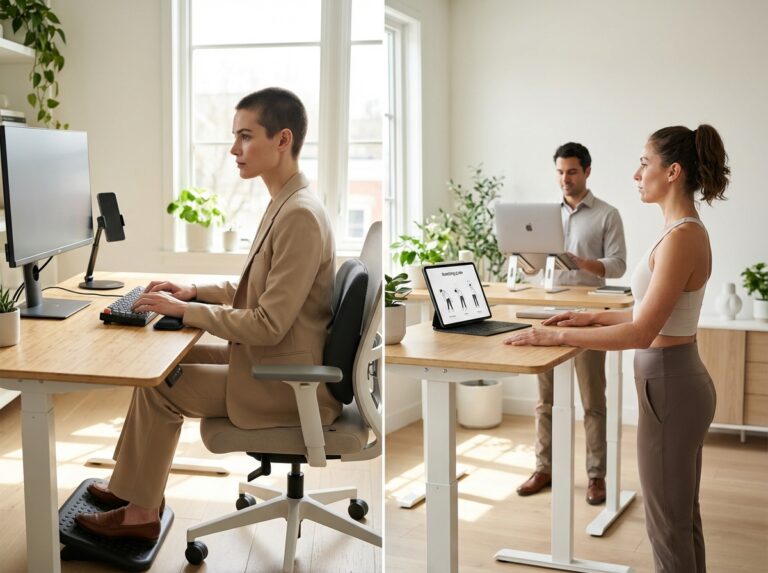
Adjust your seat height so your feet rest flat on the floor. Your knees should be at an angle between 90 and 110 degrees. If your feet dangle, the weight of your legs pulls on your lower back and tightens the hip flexors. This tension can aggravate the nerve. Use a footrest if your desk is too high to allow your feet to touch the floor while keeping your arms at the right level. Your shins should stay vertical to reduce the load on your lower back by about 20 percent. The backrest should not be perfectly vertical. Research shows that reclining the backrest to 100 or 110 degrees cuts disc pressure by half compared to a 90 degree angle. This slight lean helps maintain the natural curve of your spine and keeps the nerve from being pinched.
Monitor and Peripheral Placement
Your head position affects your entire spine. Set the top of your monitor screen at eye level. This prevents you from leaning forward or looking down. Proper monitor height reduces forward head posture by 15 degrees. Keep your keyboard and mouse close to your body. Your elbows should stay at a 90 to 100 degree angle with your wrists in a neutral position. If you use a mouse, keep it within 6 to 8 inches of your keyboard. Reaching too far for the mouse can cause a pelvic twist that irritates the sciatic nerve. For those using laptops, a docking station is essential. Using a laptop directly on a desk forces a slumped posture. Use a laptop riser and an external keyboard to achieve a neutral position. This simple change helps 90 percent of home office workers find better alignment.
Sit Stand Transition Protocols
Switching between sitting and standing is a powerful way to manage nerve pain. You should not stand all day. Standing for too long can cause fatigue and different types of back strain. Start by standing for 40 percent of your workday. Alternate between sitting and standing every 30 to 60 minutes. This movement prevents the nerve from becoming ischemic due to lack of blood flow. When standing, use an anti fatigue mat. These mats can increase your standing tolerance by 20 to 30 minutes. If you have piriformis syndrome, use a coccyx cutout cushion when you sit. These cushions reduce pressure on the tailbone and the surrounding muscles by 40 percent. This is particularly helpful for those who feel pain deep in the gluteal region.
Low Cost Home Office Hacks
You do not need to spend thousands of dollars to protect your nerve. A rolled towel can serve as a lumbar roll. Place it at the L3 to L4 level. It provides about 80 percent of the effectiveness of a professional ergonomic support. Use a stack of sturdy books to raise your monitor or laptop. If your chair is too soft, place a firm piece of plywood under a thin cushion to create a stable base. For phone calls, always use a headset. Holding a phone between your ear and shoulder creates a lateral tilt in your spine that can trigger a sciatica flare. These small adjustments are vital as the sciatica treatment market continues to grow. More people are seeking help for these issues than ever before. Taking these steps now can prevent you from becoming part of those rising statistics.
Ergonomic Checklist for Immediate Action
Follow these ten points to audit your workspace right now. These standards align with current OSHA recommendations for office safety.
| Checkpoint | Target Setting |
|---|---|
| Feet | Flat on the floor or on a stable footrest |
| Knees | Bent at 90 to 110 degrees |
| Seat Gap | 2 to 3 inches behind the knees |
| Lumbar Support | Firmly against the L3 to L4 curve |
| Backrest Angle | Reclined to 100 or 110 degrees |
| Armrests | Level with elbows to offload shoulders |
| Monitor Top | At eye level to keep neck neutral |
| Keyboard | Close to body with neutral wrists |
| Mouse | Within 8 inches of the keyboard |
| Movement | Position change every 30 to 60 minutes |
Professional Guidance and Standards
Recent data shows that 40 percent of adults in the United States will experience sciatica at some point. Proper ergonomics and core exercises can reduce the risk of recurrence by 50 percent. If you require accommodations, you can submit a formal request under the Americans with Disabilities Act (ADA). Most HR departments have specific forms for ergonomic needs; mention that an adjustable chair or standing desk is a reasonable accommodation to maintain productivity. If your pain does not improve after four weeks of using these ergonomic adjustments, you should seek a referral to a physical therapist. They can provide specific nerve glides and strengthening routines. Always stop any adjustment or movement if your pain increases beyond a 3 out of 10 on the pain scale.
Practical sitting strategies and movement routines for immediate relief
Sitting for long hours often makes sciatic pain worse because it increases lumbar flexion. This position puts pressure on the spinal discs. You can manage this irritation by making small changes to how you sit. Focus on maintaining a neutral spine. A slight anterior pelvic tilt helps many people. This means tilting your pelvis forward just enough to keep the natural curve in your lower back. It reduces the risk of a posterior disc bulge. This bulge is a common cause of nerve compression.
Movement is the best tool for immediate relief. You should not stay in one position for more than 30 minutes. Try a modified Pomodoro routine. Work for 25 minutes. Spend 5 minutes moving. During these 5 minutes, you can do gentle stretches. You can walk around the room. Research shows that microbreaks every 90 minutes can cut nerve compression risk by half.
Workday Movement Schedule
| Time Block | Activity | Benefit |
|---|---|---|
| 0-25 Minutes | Focused Work | Maintain neutral spine posture |
| 25-30 Minutes | Microbreak | Standing glute squeezes plus walking |
| 30-55 Minutes | Focused Work | Subtle weight shifts in chair |
| 55-60 Minutes | Mobility Break | Seated pelvic tilts plus nerve glides |
Seated Pelvic Tilts
You can perform relief techniques without leaving your chair. Seated pelvic tilts are effective. Do 10 repetitions every half hour. Gently rock your pelvis forward and backward. This movement reduces the pressure on the L4 and L5 levels. It keeps the lower back from becoming stiff.
Gluteal Activation
Try gluteal activation while you work. Squeeze your glutes 10 times every hour. This strengthens the muscles that support your hips. It helps stabilize the pelvis. Stronger glutes take some of the load off your lower spine.
Hamstring Decompression
Try gentle hamstring decompression. Extend one leg straight while sitting. Hold it for 10 seconds. Repeat this 5 times for each leg. This helps offload the nerve in the posterior thigh. It prevents the nerve from being pinched between the chair and your leg bones.
Habit Corrections and Acute Management
Never cross your legs. This habit increases tension in the piriformis muscle by 25 percent and can compress the sciatic nerve further. Similarly, avoid sitting on a wallet or phone in your back pocket, as this creates an uneven pelvic tilt that puts lopsided pressure on the lower spine. Keep both feet flat on the floor. If your chair is too high, use a footrest to keep your shins vertical and reduce the load on your lower back.
When you need to stand up, do it safely. Do not bend your spine forward. Use the armrests of your chair to push yourself up. This uses your arm strength. It avoids straining your back. If you use a sit-stand desk, transition slowly. Start by standing for 10 minutes every hour. You can eventually reach a mix where you stand for 40% of your day. Use an anti-fatigue mat to increase your standing tolerance. This helps distribute your weight evenly.
Managing Flare-Ups
If you experience a flare-up at work, apply ice to your lower back for 15 minutes to reduce inflammation. This is generally more effective than heat during an acute inflammatory phase. Take a five-minute walk every hour to keep the joints lubricated. Reclining your chair to 110 degrees can provide short-term relief by cutting disc pressure by 50 percent compared to sitting perfectly upright. Use this position during meetings or when reading to allow the muscles in your lower back to relax.
Practical Tips for Commuting and Meetings
Phone Use
Use a headset for phone calls. This prevents you from leaning to one side. It keeps your neck and spine aligned. Avoid holding the phone between your ear and shoulder.
Portable Support
Bring a portable lumbar support if you are driving. A rolled-up towel works well if you do not have a commercial roll. Place it at the L3 or L4 level. This simple tool can be as effective as expensive supports. It maintains the lumbar curve during long commutes.
The global Sciatica Treatment Market is growing as more people seek non-invasive relief. This reflects a shift toward better ergonomics. By using these practical strategies, you can stay productive. Most acute cases of sciatica resolve within 4 to 6 weeks with proper care. You can find more details on recovery timelines in recent 2025 Sciatica Statistics.
Document your progress. Keep a daily log of your pain levels. Note which movements provide the most relief. Small habit changes lead to long-term recovery. If your pain does not improve after 4 weeks, consult a professional. The next chapter will cover specific exercises to prevent the pain from returning. Focus on incremental changes. Consistency is more important than intensity when managing nerve irritation. Stay mindful of your posture throughout the day. Your nerve needs space to heal. Proper sitting habits provide that space.
Exercises stretches and rehab to prevent recurrence
Moving beyond simple sitting adjustments requires a structured approach to physical rehabilitation. The goal is to create a resilient environment for the sciatic nerve. This involves desensitizing the nerve, stabilizing the pelvis, and strengthening the supporting musculature. Since the sciatica treatment market is projected to grow significantly by 2035, it is clear that more office workers are seeking long term solutions rather than temporary fixes. A progressive plan lasting 4 to 12 weeks can help manage the 40 percent lifetime risk of sciatica that many Americans face.
Nerve Gliding for Beginner Relief
Seated Nerve Flossing
Nerve gliding helps the sciatic nerve move smoothly through the surrounding tissues. This technique reduces tension without overstretching the sensitive nerve fibers. Sit at the edge of your office chair with your back straight. Keep your head neutral. Slowly straighten the affected leg while simultaneously looking up at the ceiling. As you lower the leg, tuck your chin toward your chest. This coordinated movement “flosses” the nerve through the spinal canal and leg. Perform 10 repetitions. Do this three times per day. Stop immediately if your pain increases beyond a 2 out of 10 on a pain scale. Never push into sharp or radiating sensations.
Core and Pelvic Stabilization for Intermediate Progress
The Dead Bug
This exercise builds deep abdominal strength to protect the L4-S1 vertebrae. Lie on your back with your arms reaching toward the ceiling. Bend your knees to 90 degrees in a tabletop position. Slowly lower your right arm behind your head while extending your left leg toward the floor. Keep your lower back pressed firmly against the ground. Return to the starting position. Repeat on the opposite side. Aim for 3 sets of 10 repetitions. This movement stabilizes the spine. It prevents the posterior pelvic tilt that often aggravates disc issues during long work hours.
The Bird Dog
Start on your hands and knees. Ensure your wrists are under your shoulders. Your knees should be under your hips. Extend your right arm forward and your left leg backward. Hold this position for 20 seconds. Keep your hips level with the floor. Do not let your lower back arch. This exercise improves balance. It strengthens the multifidus muscles along the spine. Perform 3 sets of 5 repetitions per side. This is highly effective for remote workers with limited space because it requires only a small floor area.
Glute and Hip Strengthening for Advanced Stability
Glute Bridges
Strong glutes take the pressure off the lower back. Lie on your back with your knees bent and feet flat on the floor. Squeeze your glutes to lift your hips toward the ceiling. Hold for two seconds at the top. Lower back down slowly. Perform 3 sets of 15 repetitions. Research shows that consistent glute activation can increase strength by 40 percent over six weeks. This provides a better foundation for sitting.
Side Lying Clamshells
This targets the hip abductors and the piriformis muscle. Lie on your side with your knees bent at 45 degrees. Keep your feet together. Lift your top knee as high as possible without shifting your pelvis. Lower it back down. Perform 2 sets of 20 repetitions on each side. This helps prevent the muscle imbalances that lead to nerve compression in the hip area.
Mobility and Directional Preference
Extension vs Flexion Strategies
Most sciatica cases caused by disc herniations respond well to extension. This is known as a directional preference. If your pain moves from your foot up toward your lower back when you arch backward, this is called centralization. Centralization is a positive sign of recovery. If bending forward makes the leg pain worse, avoid deep forward folds. Use a standing lumbar extension stretch every hour at your desk. Place your hands on your lower back and gently lean backward. Hold for three seconds. Repeat five times. This helps neutralize the pressure increase caused by flexed sitting.
Rehabilitation Timeline and Progression
| Phase | Timeline | Focus | Frequency |
|---|---|---|---|
| Beginner | Weeks 1 to 3 | Nerve glides and mobility | Daily |
| Intermediate | Weeks 4 to 7 | Core stability and posture | 4 times per week |
| Advanced | Weeks 8 to 12 | Strength and power | 3 times per week |
Integration and Professional Guidance
Workday Integration
You do not need a gym to stay mobile. Use a 25/5 Pomodoro rhythm. Spend 25 minutes working. Spend 5 minutes performing one of these exercises. Seated pelvic tilts or standing hip flexor stretches fit easily into a home office routine. If you are in a meeting, perform subtle glute squeezes or seated heel lifts to maintain blood flow. CDC data indicates that chronic pain is a leading cause of lost productivity. Taking these small breaks is an investment in your career longevity.
When to Seek Help
Exercise is a powerful tool, but it has limits. Consult a physical therapist if your symptoms do not improve within four weeks. Seek immediate medical attention if you experience “red flags.” These include sudden leg weakness, numbness in the saddle area, or changes in bowel and bladder control. These symptoms may indicate cauda equina syndrome. Imaging like an MRI is usually only necessary if symptoms persist beyond 12 weeks or if neurological deficits worsen. Most acute cases resolve within 6 weeks with the right movement plan.
Recovery timeline and action plan
Managing sciatica requires a shift from passive waiting to active adjustment. Most acute cases resolve within 4 to 6 weeks with proper care. However, the sciatica treatment market continues to grow because many office workers struggle with recurrence. To break this cycle, you need a plan that addresses both your immediate workspace and your long-term physical resilience.
The 6 to 12 Week Recovery Timeline
Weeks 1 to 2: Stabilization
Focus entirely on your environment. Use the ergonomic checklist daily to ensure your feet are flat, your knees are at 90-110 degrees, and your lumbar support is correctly positioned at L3-L4. Start tracking your pain levels on a scale of 1 to 10. Most people see a 50 percent improvement in acute symptoms by the end of week 6 if they stay consistent with these changes.
Weeks 3 to 6: Building Core Strength
Introduce the dead bug exercise. Perform 3 sets of 10 repetitions. This move stabilizes the core 30 percent better than traditional crunches. Add bridges to your daily routine. Doing 3 sets of 15 reps can increase glute strength by 40 percent over 6 weeks. Strong glutes take the pressure off your sciatic nerve during sitting.
Weeks 7 to 12: Functional Progression
Move to advanced exercises like the bird dog. Hold the position for 20 seconds on each side. This improves balance and spinal stability. If you use a sit-stand desk, aim to stand for 40 percent of your day. Alternate between sitting and standing every 30 to 60 minutes to avoid leg fatigue.
Guidance for Managers and HR
Supporting employees with sciatica is a practical business decision. Non-compliance with ergonomic standards is linked to 25 percent higher back pain claims. Managers should encourage microbreaks and provide adjustable workstations. Reasonable accommodations might include a high-quality chair with a coccyx cutout or a sit-stand converter. For employees returning after a severe flare-up, offer a phased return to work. This might involve shorter shifts or increased remote work flexibility to allow for stretching and movement throughout the day.
Staying Consistent
Consistency is the only way to prevent sciatica from becoming a chronic burden. Use a daily log to track your progress. Note which sitting positions feel best and which exercises provide relief. Recovery is rarely a straight line. You might have days where the nerve feels more sensitive. Do not let a small setback stop your progress. Stick to your movement plan and keep your workspace optimized. You have the tools to manage this condition and stay productive. Confidence comes from taking these small, practical steps every single day.
References
- Sciatica Treatment Market | Global Market Analysis Report – 2035 — Sciatica treatment market is projected to grow from USD 5.6 billion in 2025 to USD 11.8 billion by 2035, at a CAGR of 7.7%. Analgesics & NSAIDs …
- Sciatica Treatment Market Advances with Minimally Invasive Care — Sciatica treatment market to crossed USD 796 million by 2025. Market projected at USD 1171.76 million by 2035. CAGR of 3.94% expected in between …
- Sciatica Treatment Market Size, Share | Industry Report, 2033 — The global sciatica treatment market size was estimated at USD 5.15 billion in 2024 and is projected to reach USD 10.71 billion by 2033, growing at a CAGR …
- Sciatica Treatment Market Size, Share, Trends | Statistics [2032] — The global sciatica treatment market size was valued at $5.38 billion in 2024 & is projected to grow from $5.92 billion in 2025 to $11.78 billion by 2032.
- 2025 Sciatica Statistics: Prevalence, Recovery Rates & More — How long do most cases of sciatica take to resolve? … Most acute cases of sciatica resolve within 4 to 6 weeks, especially with early treatment and rest.
- Sciatica Treatment Market Analysis, Size, and Forecast 2025-2029 — The global Sciatica Treatment Market size is expected to grow USD 3620.6 million from 2025-2029, expanding at a CAGR of 4.6% during the forecast period.
- Sciatica Market Size, Share, and Future Growth Insights 2025-2032 — The Sciatica Market will grow at CAGR 5.7% between 2025–2032, moving from $8.65 billion in 2024 to $13.47 billion.
- What doctors wish patients knew about sciatica — In the U.S., about 40% of people experience some form of sciatica during their lifetime. Yet it rarely happens before 20 years old unless it is …
- Sciatica Market Size, Share & Forecast (2025–2032) Driven by … — Ans: Global Sciatica Market is projected to grow from USD 7.28 billion in 2024 to nearly USD 12.05 billion by 2032, at a CAGR of 6.5%, driven by …
Legal Disclaimers & Brand Notices
The information provided in this article is for informational and educational purposes only and does not constitute professional medical advice, diagnosis, or treatment. Always seek the advice of a physician or other qualified healthcare provider with any questions you may have regarding a medical condition, particularly when experiencing “red flag” symptoms such as sudden weakness or loss of sensation. Never disregard professional medical advice or delay in seeking it because of something you have read in this content.
All product names, logos, and brands mentioned in this text are the property of their respective owners. All company, product, and service names used in this article are for identification purposes only. Use of these names, logos, and brands does not imply endorsement.