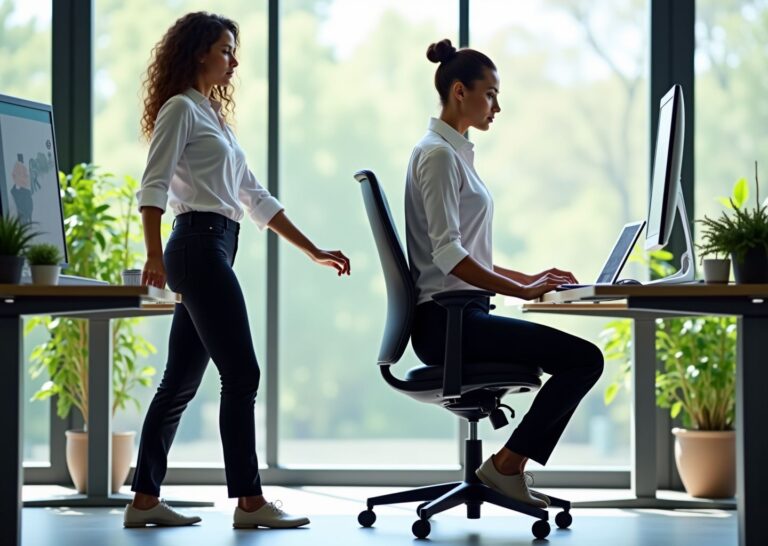
A short, structured 5-minute desk yoga routine can ease stress, reduce musculoskeletal strain, and boost focus for office workers and remote teams. This article explains why micro-movement matters, shows a step-by-step routine you can do at your workstation, answers common questions about safety and frequency, and explains how to integrate these stretches into an ergonomic desk setup.
Why a 5-Minute Desk Yoga Routine Works
It might seem counterintuitive that just five minutes of gentle movement at your desk can make a real difference. We’re often told that meaningful exercise requires a gym membership, a full hour, and a change of clothes. But when it comes to combating the physical and mental toll of a sedentary job, the science points in a different direction. The power isn’t in the duration; it’s in the frequency and consistency. A short, targeted desk yoga routine works because it directly counteracts the specific ergonomic risks of office work while leveraging the proven benefits of microbreaks.
The human body is not designed to sit still for eight hours a day. When we do, we fall into predictable, harmful patterns. Our necks flex forward to look at screens, rounding our shoulders and straining the upper back. Our wrists remain in static, often awkward, positions while typing and using a mouse. Our hips tighten, and circulation to our lower body slows down. These aren’t just minor discomforts; they are ergonomic risk factors that can lead to chronic pain, repetitive strain injuries, and burnout. A five-minute routine acts as a physiological reset button. Gentle neck stretches release tension in the trapezius muscles, while seated cat-cow movements mobilize the thoracic spine, improving posture and preventing that all-too-common slump. Wrist circles and forearm stretches increase blood flow and relieve pressure on the delicate nerves running through the carpal tunnel. These movements aren’t about building muscle; they’re about restoring mobility and interrupting the cycle of static tension before it becomes chronic pain.
The benefits extend beyond the purely physical. The routine’s emphasis on controlled breathing is a key component for stress management. Slow, deep breathing activates the parasympathetic nervous system, your body’s “rest and digest” mode. This process actively lowers your heart rate, reduces blood pressure, and decreases levels of the stress hormone cortisol. Studies show that even a few minutes of mindful breathing can significantly lower perceived stress. When you’re staring down a deadline or navigating a difficult conversation, taking a moment to breathe and move can provide the mental clarity needed to respond thoughtfully instead of reacting impulsively. This isn’t just a feeling; it’s a measurable physiological shift. Research has shown that just 15 minutes of movement a day can lower stress levels by nearly 15% and boost productivity by over 30% within a week.
This is where the science of microbreaks becomes so important. For busy employees, the idea of a 60-minute lunch break for a workout is often unrealistic. A five-minute routine, however, is achievable. It succeeds where longer exercise fails because it integrates seamlessly into the workday. The goal isn’t to replace a full workout but to supplement it by breaking up long periods of sitting. Research on productivity shows that short, frequent breaks are more effective at maintaining focus and energy than fewer, longer ones. After about two hours of continuous desk work, mental performance begins to decline. A quick yoga session can reverse that, boosting circulation to the brain and refreshing your focus for the next task.
This practice is particularly beneficial for anyone in a sedentary job. This includes remote workers who may lack the natural movement breaks of an office environment (like walking to a meeting room or grabbing coffee), hybrid teams navigating inconsistent schedules, and anyone already experiencing mild symptoms of repetitive strain, such as wrist aches or neck stiffness. It’s a proactive tool for prevention and a gentle remedy for existing discomfort. However, it’s important to listen to your body. If you are experiencing acute or severe pain, have a recent injury, or have undergone surgery, it’s crucial to consult a doctor or physical therapist before starting any new movement routine.
For managers and team leads, fostering a culture that supports these breaks is key. Normalizing short movement breaks can boost team morale and productivity. You can encourage this by leading by example, starting a virtual meeting with a 30-second neck stretch, or using team chat to send out a friendly reminder to “stand up and stretch.” Making it clear that employee well-being is a priority helps remove any guilt or pressure associated with stepping away from the keyboard. It reinforces the idea that taking five minutes to care for your body isn’t slacking off; it’s a smart investment in sustained focus and long-term health.
Step by Step 5-Minute Desk Yoga Routine
This sequence is designed to be done right at your desk, in your work clothes. All you need is your chair and five minutes. Set a timer, take a deep breath, and let’s begin. The goal is gentle movement, not a strenuous workout. Listen to your body and only move within a range that feels good.
1. Grounding Breath and Posture Reset (Duration: 30 seconds)
This first step is about arriving. It shifts your focus from your screen to your body. Sit toward the front edge of your chair with your feet flat on the floor, hip-width apart. Your knees should be directly over your ankles, creating a stable base. Rest your hands on your thighs, palms up or down.
- Instructions: Inhale slowly through your nose for a count of four, feeling your spine grow taller as if a string is gently pulling the crown of your head upward. Exhale slowly through your mouth for a count of six, allowing your shoulders to melt down and away from your ears. Repeat this cycle for 30 seconds.
- Breathing Cue: Inhale length, exhale softness.
- Common Mistakes: Avoid arching your lower back or tensing your jaw and neck. Let the breath be easy, not forced.
- Modifications: If your feet don’t comfortably reach the floor, slide a book or a small box underneath them. For chairs with wheels, ensure you are stable, perhaps by bracing the chair against your desk.
2. Seated Neck Mobility (Duration: 60 seconds)
We hold so much tension in our necks from looking at screens. This series of slow, deliberate movements helps release that stiffness.
- Instructions:
- Chin Tucks (20 sec): On an exhale, gently lower your chin toward your chest. Don’t force it. Inhale and lift your head back to a neutral position.
- Lateral Stretches (20 sec): Exhale and slowly tilt your right ear toward your right shoulder, keeping the left shoulder down. Hold for a breath. Inhale back to center. Repeat on the left side.
- Gentle Rotations (20 sec): Exhale and turn your head to look over your right shoulder, just until you feel a light stretch. Inhale back to center. Repeat on the left side.
- Breathing Cue: Let your exhale guide the movement into the stretch.
- Common Mistakes: Never roll your neck in a full circle, as this can compress the cervical spine. Avoid shrugging your shoulders up toward your ears; keep them relaxed.
- Modifications: For a deeper stretch, you can place a hand on the opposite side of your head and add very gentle pressure. For limited mobility, keep the movements small and well within a pain-free range.
3. Upper Back Opening and Thoracic Extension (Duration: 45 seconds)
This move, a seated version of Cat-Cow, counteracts the forward hunch that’s so common at a desk. It focuses on mobilizing your thoracic spine (your upper and mid-back).
- Instructions: Place your hands on your knees. On an inhale, gently arch your spine, lift your chest forward and up, and look slightly toward the ceiling (Cow pose). On an exhale, round your spine, tuck your chin to your chest, and draw your navel toward your back (Cat pose). Flow smoothly between these two positions.
- Breathing Cue: Inhale to open the chest (Cow), exhale to round the spine (Cat).
- Common Mistakes: Initiating the movement from your lower back instead of your upper back. Avoid craning your neck back sharply in Cow pose; the gaze should lift naturally.
- Modifications: If placing hands on your knees is uncomfortable, try clasping your hands behind your head with elbows wide. Inhale to press your head back and open your chest, exhale to gently bring your elbows toward each other. For pregnancy, keep the movements smaller and avoid any strong abdominal contractions.
4. Shoulder Rolls and Scapular Squeezes (Duration: 30 seconds)
This combination releases tension from the tops of the shoulders and strengthens the muscles between your shoulder blades, which are crucial for good posture.
- Instructions: First, inhale and lift your shoulders straight up to your ears. Exhale and roll them back and down. Repeat 5 times, then reverse the direction for 5 forward rolls. Next, bring your arms into a “cactus” or goalpost shape, with elbows bent at 90 degrees. Exhale and gently squeeze your shoulder blades together as if holding a pencil between them. Inhale to release. Perform 10 slow squeezes.
- Breathing Cue: Exhale on the effort, whether it’s rolling down or squeezing back.
- Common Mistakes: Rushing the movements. Focus on the muscular engagement rather than just moving your arms.
- Modifications: If you have limited space, you can perform the shoulder rolls with your fingertips resting on your shoulders.
5. Wrist and Forearm Release (Duration: 30 seconds)
Constant typing and mouse use create repetitive strain. These simple stretches provide immediate relief.
- Instructions: Extend your right arm forward, palm up. With your left hand, gently bend your right fingers down toward the floor. Hold for 10 seconds. Then, flip your palm to face down and gently bend your wrist down. Hold for 10 seconds. Switch hands and repeat. Finish by making gentle fists and circling your wrists 5 times in each direction.
- Breathing Cue: Breathe steadily throughout, sending your breath to the area of sensation in your forearm.
- Common Mistakes: Pulling too hard on your fingers or wrist, which can cause pain. The stretch should feel gentle and relieving.
- Modifications: If you have wrist pain or carpal tunnel, perform these movements with extreme care. An alternative is the “prayer stretch,” where you press your palms together at your chest and then slowly lower them toward your waist until you feel a stretch.
6. Seated Side Bends and Gentle Seated Twist (Duration: 45 seconds)
These movements lengthen the sides of your body and decompress the spine.
- Instructions: For the side bend, keep both sit bones firmly on the chair. Inhale and reach your right arm straight up. Exhale and bend to your left, feeling a stretch along your right side. Inhale back to center and lower the arm. Repeat on the other side. For the twist, inhale to sit tall. Exhale and gently rotate your torso to the right, placing your left hand on your right thigh and your right hand on the back or side of your chair. Use the exhale to deepen the twist slightly. Hold for a breath, then return to center and repeat on the left.
- Breathing Cue: Inhale to create length in your spine, exhale to bend or twist into the space you’ve created.
- Common Mistakes: Lifting a hip off the chair during the side bend. Using your arms to yank yourself into the twist; the rotation should come from your core and spine.
- Modifications: For pregnancy, make the twist an “open” one, twisting away from your knees, and keep it focused on the upper back and shoulders. If your chair swivels, plant your feet firmly to prevent it from moving with you.
7. Seated Hip Opener and Hamstring Flush (Duration: 30 seconds)
Sitting for long periods can tighten your hips and hamstrings. This pose targets the glutes and piriformis muscle.
- Instructions: Cross your right ankle over your left knee, creating a “figure four” shape. Keep your right foot flexed to protect the knee joint. Inhale to lengthen your spine. As you exhale, hinge forward from your hips with a flat back until you feel a stretch in your right hip. Hold for 15 seconds, then slowly come up and switch sides.
- Breathing Cue: Exhale as you hinge forward to deepen the stretch.
- Common Mistakes: Rounding your back to get lower. The goal is to pivot from the hips, not curve the spine.
- Modifications: If this is too intense or you have limited legroom, simply cross your ankles and hinge forward. Alternatively, extend one leg straight out under your desk, flex the foot, and hinge forward to stretch the hamstring. If you feel comfortable, you can also perform this move standing, using your desk for balance.
8. Closing Breath and Micro Posture Check (Duration: 30 seconds)
This final moment helps you transition back to your work with renewed awareness.
- Instructions: Return to your initial grounded posture with feet flat on the floor. Close your eyes if it feels right. Take one final, deep breath in through your nose, and let it all go with a slow, audible sigh out of your mouth. Before opening your eyes, do a quick mental scan: Are your shoulders relaxed? Is your jaw soft? Is your spine tall?
- Breathing Cue: A full, cleansing breath to seal your practice.
- Common Mistakes: Immediately jumping back into your work without taking a second to notice how you feel.
- Modifications: As you finish, set a simple ergonomic intention for the next hour, such as “I will keep my wrists neutral” or “I will sit back fully in my chair.”
To make this a lasting habit, try linking it to an existing part of your day, like right after your morning coffee or before your lunch break. Set a recurring calendar reminder or use a timer app. For teams, a simple message in a group chat can serve as a collective prompt, turning a solo activity into a shared moment of well-being. These quick wellness activities are most effective when they become a consistent part of your workday rhythm.
Common Questions About Desk Yoga
Can I do this at my desk with coworkers around?
Yes, absolutely. The routine from the previous chapter was designed to be subtle. The movements are small, quiet, and can be done right in your chair without drawing much attention. Most people are focused on their own work and likely won’t even notice. If you feel a bit self-conscious, you can turn your chair slightly away from the main line of sight. For remote workers on a video call, simply turning your camera off for a few minutes is a perfect solution. The goal is to make this practice accessible, not a public performance.
How often should I practice?
Consistency is more important than duration. For the best results, aim to complete the full five-minute routine two to three times throughout your workday. The best times to practice are often at the start of your shift to set a positive tone, after a long meeting to release built-up tension, or during the mid-afternoon slump to re-energize your mind and body. Even a quick one-minute stretch every hour can be incredibly effective. The key is to build a sustainable habit that breaks up long periods of sitting, which is known to increase stress levels after just a couple of hours.
What if I have chronic neck or wrist pain?
If you have a diagnosed condition or experience persistent pain, it is essential to consult with your doctor or a physical therapist before starting any new routine. This desk yoga sequence is designed to alleviate mild tension from sedentary work, not to treat a medical issue. For general stiffness, you can modify the exercises by moving through a smaller, pain-free range of motion. Never push into a sharp or radiating pain. A study of home-office workers found that a month of daily 10-minute yoga sessions significantly reduced discomfort in the neck, back, and wrists, so gentle, consistent movement can be very beneficial for common desk-related aches.
Is it safe during pregnancy?
For most, yes, but always check with your healthcare provider first. Pregnancy changes your body’s ligaments and center of gravity, so caution is key. You will need to modify certain poses. Avoid deep twists that compress the abdomen; instead, turn gently from your upper back and shoulders. When doing forward folds, keep your spine long and hinge from the hips only as far as it feels comfortable, leaving plenty of space for your belly. Focus on the neck, shoulder, and wrist stretches, which are generally safe and very helpful.
Do I need special clothes or equipment?
No, not at all. This routine was created for the reality of a workday. You can do all the movements in your regular work attire, whether that’s a suit or casual clothes. The only piece of equipment you need is a stable chair, preferably one that doesn’t swivel too easily during the seated twists. No yoga mat, blocks, or special gear required.
Will this replace physical therapy or exercise?
This is a firm no. Think of this 5-minute routine as a supplement, not a substitute. It is a tool for managing workday stress and stiffness, much like adjusting your monitor height. It is not a replacement for medical treatment from a physical therapist for an injury, nor does it count as a full workout for cardiovascular health or strength training. It complements an active lifestyle by specifically targeting the negative effects of prolonged sitting.
How long before I see benefits?
You will likely feel some benefits immediately. The breathing exercises can lower your stress in the moment. After just one week of consistent practice, you may notice less stiffness in your neck and shoulders. Studies show that people who incorporate short movement breaks feel more relaxed and focused in as little as a week. For more lasting changes, like improved posture and a significant reduction in chronic tension, give it a few weeks to a month. The small, daily efforts compound over time.
How can I encourage my remote team and managers to participate?
Focus on the practical benefits that impact work, like improved focus and productivity. You can share that research shows short movement breaks can boost productivity by over 30%. For managers, framing it as a low-cost tool to support team well-being and prevent burnout is effective.
A manager could say: “Team, to help us all stay fresh during our long calls, let’s start our next meeting with a quick two-minute stretch. Cameras off, no pressure. It’s just a moment to reset before we dive in.”
Or for a team-wide message: “I encourage everyone to block out 5 minutes on your calendar this afternoon for a quick stretch break. It’s a proven way to clear your head and come back to your work with more energy.”
What are the signs I should stop or modify an exercise?
Your body’s signals are the most important guide. You should stop immediately if you feel any sharp, stabbing, or shooting pain. Other red flags include numbness, tingling, or dizziness. It’s important to distinguish between the mild discomfort of a muscle being stretched and actual pain. If a movement hurts, the first step is to reduce the intensity or range of motion. If it still hurts, skip that particular exercise. The motto here is “no pain, no pain.”
Are there legal or HR considerations for group breaks?
When introducing this to a team, it’s best to frame it as a voluntary wellness activity, not a mandatory requirement. This avoids any pressure or implication that it’s a required physical task. Ensure the language is inclusive, always mentioning that movements can be modified or skipped based on individual comfort and ability. For managers wanting to formalize it, positioning it within a broader company wellness initiative is a good approach. It’s a supportive gesture, not a mandated exercise class.
A manager could propose to HR: “I’d like to introduce voluntary 5-minute wellness breaks for my team to combat screen fatigue. The activities are gentle, chair-based, and optional. This aligns with our goal of fostering a healthy and productive work environment.”
Practical Takeaways and Next Steps
You’ve learned the what and the why behind our 5-minute desk yoga routine. Now it’s time to put that knowledge into action. Understanding the benefits is one thing, but consistently applying the practice is what creates real, lasting change in how you feel at your desk. This isn’t about adding another complex task to your day. It’s about integrating a simple, powerful tool that gives back far more time in focus and comfort than it takes to perform. The evidence is clear; even brief movement breaks can significantly lower stress and boost productivity. Think of this as a strategic pause that resets your body and mind, allowing you to return to your work with renewed energy and less physical strain.
The path from knowing to doing is often the hardest part, so we’ve broken it down into a simple plan. Use the following checklist to seamlessly weave this 5-minute routine into your workday.
-
Set a Reminder Cadence.
Habits thrive on consistency, and consistency is built on triggers. Don’t rely on memory alone, especially when you’re focused on a task. Set a recurring alarm on your phone or a calendar notification. A good starting point is one session a day, perhaps during the mid-afternoon slump when energy typically dips. After a week, try adding a second session, maybe to kickstart your morning or to decompress after a long meeting. The goal is to find a rhythm that works for you. Some people find success by “habit stacking,” linking their stretch break to an existing routine. For example, you could decide to do your 5-minute yoga sequence every time you refill your water bottle or right after you return from lunch. The trigger makes the action automatic over time. -
Choose Your Spot and Set the Etiquette.
The environment you stretch in matters. If you’re in an open office, you might feel self-conscious. Look for a quiet corner, an empty conference room, or even a wide hallway where you won’t be in the way. The key is to find a place where you can focus on your body for five minutes without feeling watched. For remote workers, the challenge is different. It’s about setting boundaries during video calls. Establish a personal or team-wide etiquette that turning your camera off for a few minutes to stretch is perfectly acceptable and even encouraged. A simple message in the chat like, “Taking a quick stretch break, camera off for a moment,” can normalize the behavior for everyone. This removes the social barrier and makes it easier to prioritize your wellbeing. -
Pair Stretches with Ergonomic Resets.
Stretching provides temporary relief, but pairing it with ergonomic adjustments addresses the root cause of the strain. Think of them as a team. Use your 5-minute break as a chance to perform a quick workstation audit. As you do your neck stretches, ask yourself, “Is my monitor at eye level?” Adjust it so you’re looking straight ahead, not down. While doing wrist releases, check your keyboard and mouse placement. Your wrists should be straight, not bent up or down. As you perform seated twists, notice your lower back. Does your chair provide adequate lumbar support? If not, a small pillow or a rolled-up towel can make a huge difference. This integrated approach ensures that the relief you gain from stretching lasts longer because you’re not immediately returning to a posture that creates tension. -
Track Symptoms and Improvements.
What gets measured gets managed. Tracking your progress provides powerful motivation because it makes the benefits tangible. You don’t need a complicated system. Simply use a notebook or a notes app on your phone. At the end of each day, rate your neck, back, and wrist stiffness on a scale of 1 to 5. Also, note how many times you had to stop work due to pain or discomfort. After a week or two of consistent practice, you’ll have concrete data showing your improvement. Seeing those numbers go down is incredibly rewarding and reinforces the value of your new habit. Research from a 2024 NIH study showed that just 10 minutes of daily yoga for one month significantly reduced musculoskeletal discomfort for home-office workers, confirming that small inputs yield major results. -
Escalate Persistent Pain.
This routine is for general stiffness, not a substitute for medical care. Listen to your body: if you experience sharp, shooting, or persistent pain—especially with numbness or tingling—it is a clear signal to stop and consult a doctor or physical therapist. Knowing when to escalate from self-care to professional care is a crucial part of maintaining your long-term health.
So, how do you know it’s working? After about two weeks of sticking with the routine, perform a simple self-evaluation. You don’t need complex analytics. Just pay attention to these three simple metrics. First, notice your level of stiffness, particularly in your neck and shoulders when you wake up or after a long period of sitting. It should feel noticeably reduced. Second, count how often you find yourself instinctively stopping work to rub your neck or stretch your back. You should find you’re taking fewer unplanned breaks due to pain. Finally, assess your ability to concentrate, especially during that post-lunch energy dip. You may find your focus is sharper and lasts longer, a direct benefit of improved blood flow and reduced physical distraction. A recent survey highlighted that just 15 minutes of movement a day can improve focus by nearly 29%, and our 5-minute routine is a perfect starting point.
To make this habit stick for the long haul, shift your focus from discipline to feeling. Don’t think of it as another task to check off your list. Instead, concentrate on the immediate sense of relief in your shoulders or the feeling of space you create in your spine. Let that positive feedback be your motivation. And remember, consistency beats intensity. A simple 3-minute stretch on a busy day is far better than skipping it entirely.
Finally, consider sharing this routine with your team. Encouraging collective wellbeing can transform a work culture. You could suggest starting a long meeting with a 2-minute guided neck stretch or share a link to this article in your team’s chat channel. When wellness becomes a shared value, it creates a more supportive, energetic, and healthy environment for everyone.
Sources
- Yoga at Your Desk: 5-Minute Break to Relief Stress and Boost … — Improves mindfulness, self-efficacy, and other cognitive skills · Enhances your ability to focus · Improves emotional control · Helps with relaxation and stress …
- Just 15 minutes of movement a day reduces work stress, survey shows — The 15-minute intervention · Stress levels were lowered by 14.7% · Productivity increased by 33.2% · Focus improved by 28.6% · People said they felt …
- 12 Quick 5-Minute Wellness Activities For Employees – Vantage Fit — Here are 12 quick 5-minute wellness activities you can introduce at work today: Desk stretches. Box breathing. Chair yoga. Eye relaxation break.
- Impact of 10-Min Daily Yoga Exercises on Physical and Mental … – NIH — Evaluate the effects of 10 min/day of yoga for 1 month on musculoskeletal discomfort and mood disturbance of home-office workers.
- Reduce stress and the risk of burnout by using yoga techniques … — Those whose motivation was stress reduction most often indicated that the effect of yoga practice was stress relief (17%). Those motivated …
- 5-Minute Yoga Breaks for Holiday Stress Relief (2024) — Holiday stress is real. These 5-minute yoga poses and routines provide instant relief – no mat or equipment needed.
- Reducing Stress with Yoga: A Systematic Review Based on … — Yoga promotes both physical and mental relaxation, which lowers anxiety and stress.[4] It includes the practice of meditation, precise postures …
Legal Disclaimers & Brand Notices
The content provided in this article, including all descriptions of exercises, routines, and health benefits, is for informational and educational purposes only. It is not intended to be a substitute for professional medical advice, diagnosis, or treatment from a qualified healthcare provider, physical therapist, or physician. Always seek the advice of your doctor or other qualified health professional with any questions you may have regarding a medical condition, injury, or before starting any new exercise routine.
If you experience any sharp pain, numbness, tingling, or dizziness while performing these exercises, stop immediately and consult a medical professional. Reliance on any information provided by this article is solely at your own risk.
All product names, logos, and brands mentioned or referenced herein are the property of their respective owners.